Understanding Sails WebSockets: A Modern, Unified Approach to Real-Time in Node.js

Kelvin Omereshone
@Dominus_Kelvin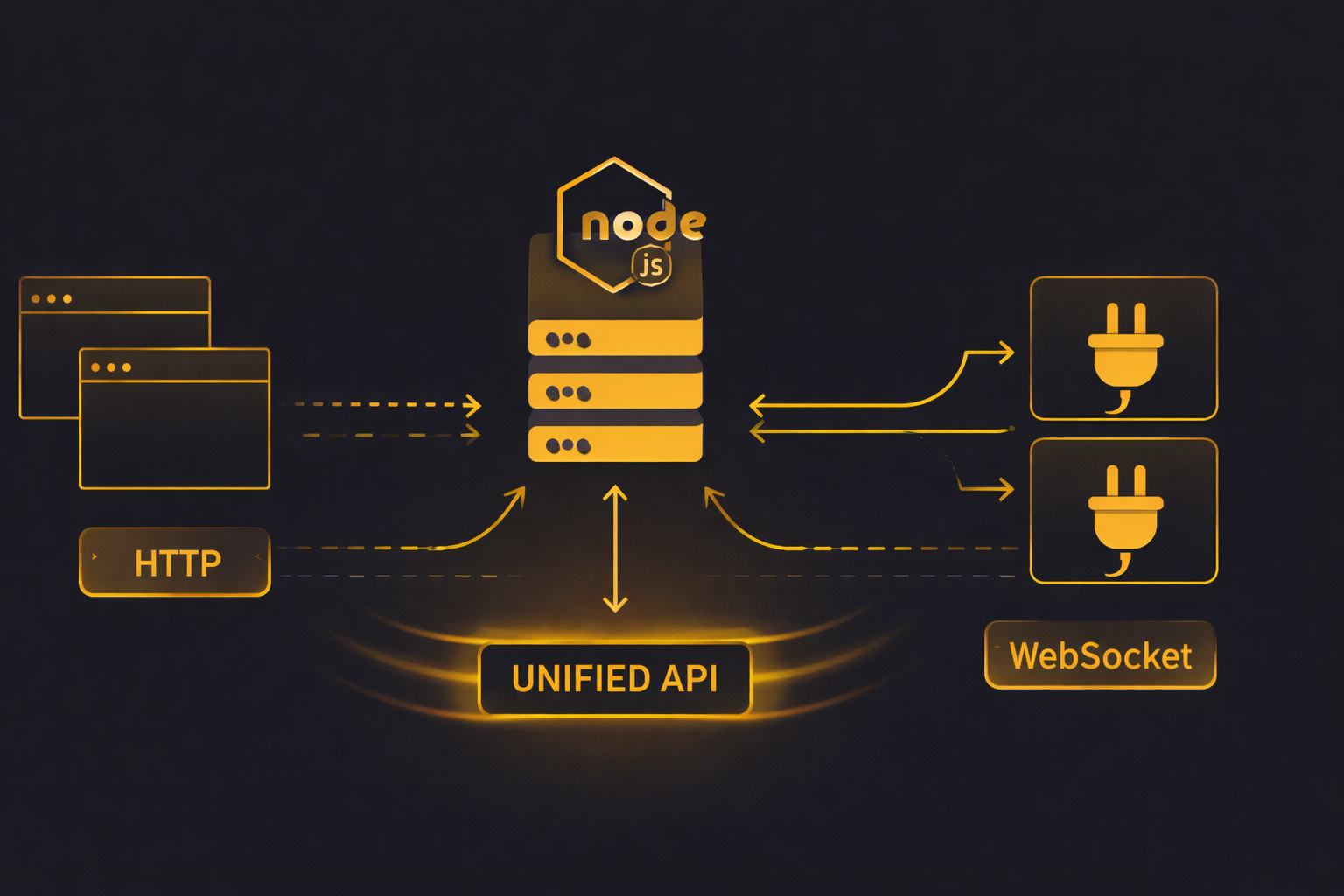
Introduction
Adding real-time features to a Node.js application typically means maintaining two parallel codebases: one for HTTP and another for WebSockets. You end up duplicating validation logic, authorization checks, and business rules across both transports. It’s tedious, error-prone, and increases your maintenance burden.
Sails.js takes a different approach.
Instead of treating HTTP and WebSockets as separate concerns, Sails unifies them through an elegant abstraction called the virtual request pattern. This allows you to write your application logic once and have it work seamlessly across both protocols.
In this article, we’ll explore how Sails achieves this unification, examining the virtual request pattern, JSON WebSocket Responses (JWR), and the role of sails-hook-sockets in making it all work. For a detailed examination of the virtual request pattern’s implementation, see The Virtual Request Pattern in Sails.js.
The Challenge of Dual-Protocol Development
Traditional web frameworks treat HTTP and WebSockets as fundamentally different paradigms. Express, for instance, requires separate route handlers for HTTP endpoints and Socket.IO event listeners. This architectural separation forces you to implement the same business logic twice—once for each protocol.
The result? Code duplication, divergent implementations, and subtle bugs that only appear in one transport layer.
Sails solves this by asking a deceptively simple question: what if WebSocket messages could be treated as HTTP requests? This conceptual shift eliminates the duplication entirely.
Understanding sails-hook-sockets
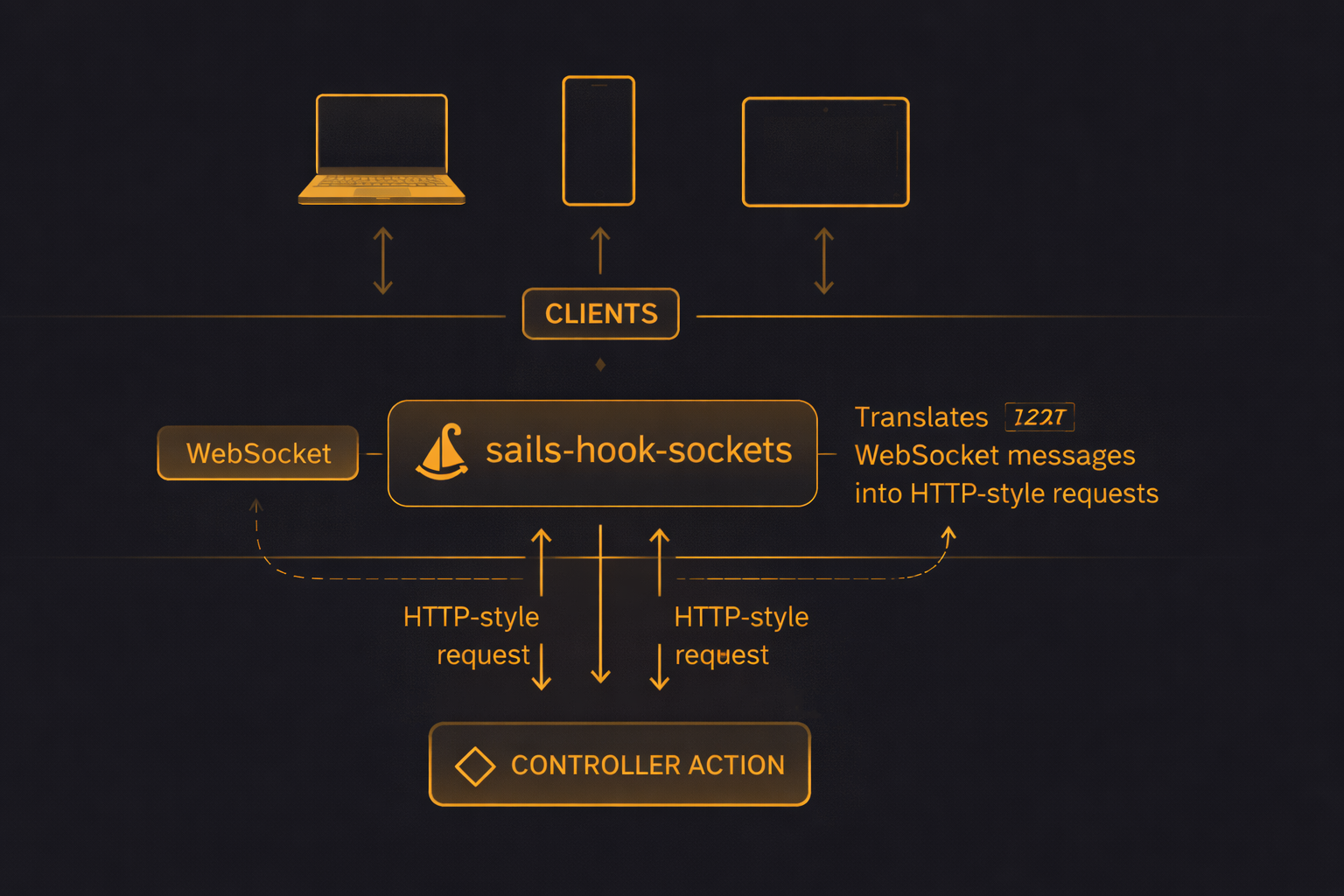
The heavy lifting behind Sails’ unified approach is handled by sails-hook-sockets, a core hook that integrates Socket.IO into the framework. This module acts as an adapter layer, translating WebSocket messages into a format that Sails’ router can understand.
When you start a Sails application, sails-hook-sockets:
- Initializes a Socket.IO server alongside your HTTP server
- Manages socket lifecycle events (connection, disconnection, reconnection)
- Exposes a programmatic API through
sails.sockets.*for broadcasting, room management, and direct socket communication - Handles session persistence and authentication state across persistent connections
- Coordinates cross-server communication when scaling with Redis
The hook’s primary innovation is its ability to transform incoming WebSocket messages into virtual HTTP requests that flow through your existing routing layer.
The Virtual Request Pattern
The virtual request pattern is Sails’ answer to protocol unification. When a WebSocket message arrives, sails-hook-sockets constructs a synthetic request/response pair that mirrors the standard HTTP request/response objects.
This transformation involves three steps:
-
Request synthesis: The incoming socket message is parsed and used to build a request object (
req) with all the properties you’d expect from an HTTP request: method, URL, headers, body, session, and more. -
Response adaptation: A corresponding response object (
res) is created with methods likejson(),status(), andsend()that buffer the output instead of writing directly to a socket. -
Router integration: The virtual request/response pair is passed to Sails’ standard routing layer, where it’s handled by the same actions, policies, and middleware that process HTTP requests.
The request object includes an isSocket property for the rare cases where you need protocol-specific behavior, though the abstraction typically eliminates this need.
Example:
// api/controllers/user/get-users.js
module.exports = {
  friendlyName: 'Get users',
  description: 'Get a list of all users',

  exits: {
    success: {
      description: 'Users retrieved successfully',
    },
  },

  fn: async function () {
    const users = await User.find();
    return { users };
  },
};
This single action handles both:
GET /usersrequests over HTTPio.socket.get('/users')calls over WebSockets
No code duplication, no protocol-specific handlers, no conditional logic. The abstraction is complete.
JWR: HTTP Semantics Over WebSockets
When your action returns a response through a virtual request, Sails serializes it into a JSON WebSocket Response (JWR). This format preserves HTTP semantics while remaining compatible with Socket.IO’s message-based protocol:
{
  "body": { "users": [...] },
  "statusCode": 200,
  "headers": { "content-type": "application/json" }
}
Clients receive the same status codes, headers, and response bodies they’d expect from HTTP. This means your error handling, status code logic, and content negotiation remain consistent across both protocols.
The Client Side: sails.io.js
On the client side, Sails provides sails.io.js—a lightweight wrapper around Socket.IO that exposes an HTTP-like API. Methods such as io.socket.get(), io.socket.post(), and io.socket.patch() mirror their HTTP counterparts but operate over a persistent WebSocket connection.
The library handles several important details automatically:
- Connection management and automatic reconnection
- Request queueing when the connection is temporarily unavailable
- Session cookie synchronization via a special
GET /__getcookieshadow route during the initial handshake
This shadow route is bound automatically by sails-hook-sockets and remains invisible to application developers, but it’s critical for ensuring session persistence across the WebSocket connection.
Session Management and Authentication
Sails manages session state for WebSocket connections using the same session store as HTTP requests. The process works as follows:
-
Session initialization: When a socket connects, sails-hook-sockets extracts the session cookie from the handshake headers and loads the corresponding session data.
-
Stateless fallback: For clients without cookies (such as native mobile apps), Sails generates a temporary session that persists for the duration of the connection.
-
State persistence: Session modifications made during the connection (such as authentication events) are persisted and remain available for subsequent messages.
This architecture ensures that your authentication policies, authorization checks, and user context operate identically across HTTP and WebSocket requests. The “logged in via HTTP but anonymous via WebSocket” problem simply doesn’t exist.
Broadcasting and Room Management
For server-initiated communication (as opposed to request/response patterns), Sails provides a broadcasting API built on Socket.IO’s room concept:
sails.sockets.broadcast(room, event, data): emit an event to all sockets subscribed to a specific roomsails.sockets.join(socket, room): subscribe a socket to a roomsails.sockets.leave(socket, room): unsubscribe a socket from a room
These rooms are coordinated across multiple server instances when using Redis as a message broker, enabling horizontal scaling without sacrificing real-time capabilities.
Horizontal Scaling with Redis
Sails includes built-in support for scaling WebSocket connections across multiple server instances using Redis as a message broker. The sails-hook-sockets module manages the underlying pub/sub channels and maintains an “admin bus” for coordinating state between servers.
This architecture allows you to broadcast messages to rooms, maintain session consistency, and distribute millions of concurrent connections across your infrastructure without additional configuration.
Key Benefits
The virtual request pattern delivers several architectural advantages:
- Reduced complexity: Application logic is written once and works across both protocols, eliminating an entire category of duplication bugs.
- Consistent semantics: HTTP status codes, headers, and response formats remain consistent whether the request arrives via HTTP or WebSocket.
- Unified authentication: Session management and authorization policies apply uniformly across both transports.
- Simplified testing: You can test your actions with standard HTTP requests, confident they’ll behave identically over WebSockets.
This approach doesn’t force you to choose between protocols or maintain parallel implementations. You simply write your application logic, and the framework handles the protocol translation.
Conclusion
Sails’ approach to WebSockets represents more than a technical convenience—it’s a fundamental rethinking of how protocols should be handled in modern web frameworks. By abstracting WebSocket messages into virtual HTTP requests, Sails eliminates the false dichotomy between request/response and real-time architectures.
The sails-hook-sockets module makes this abstraction possible, serving as the translation layer between Socket.IO’s event-based model and Sails’ routing system. The result is a development experience where protocol concerns fade into the background, allowing you to focus on application logic rather than transport mechanics.
For teams building real-time applications in Node.js, this unified approach significantly reduces complexity, maintenance burden, and the surface area for bugs. Consider exploring Sails and The Boring JavaScript Stack if you’re building applications that require real-time features.
Join the Sails Discord to connect with the community.