Understanding Parley: The Deferred Pattern Powering Sails

Kelvin Omereshone
@Dominus_Kelvin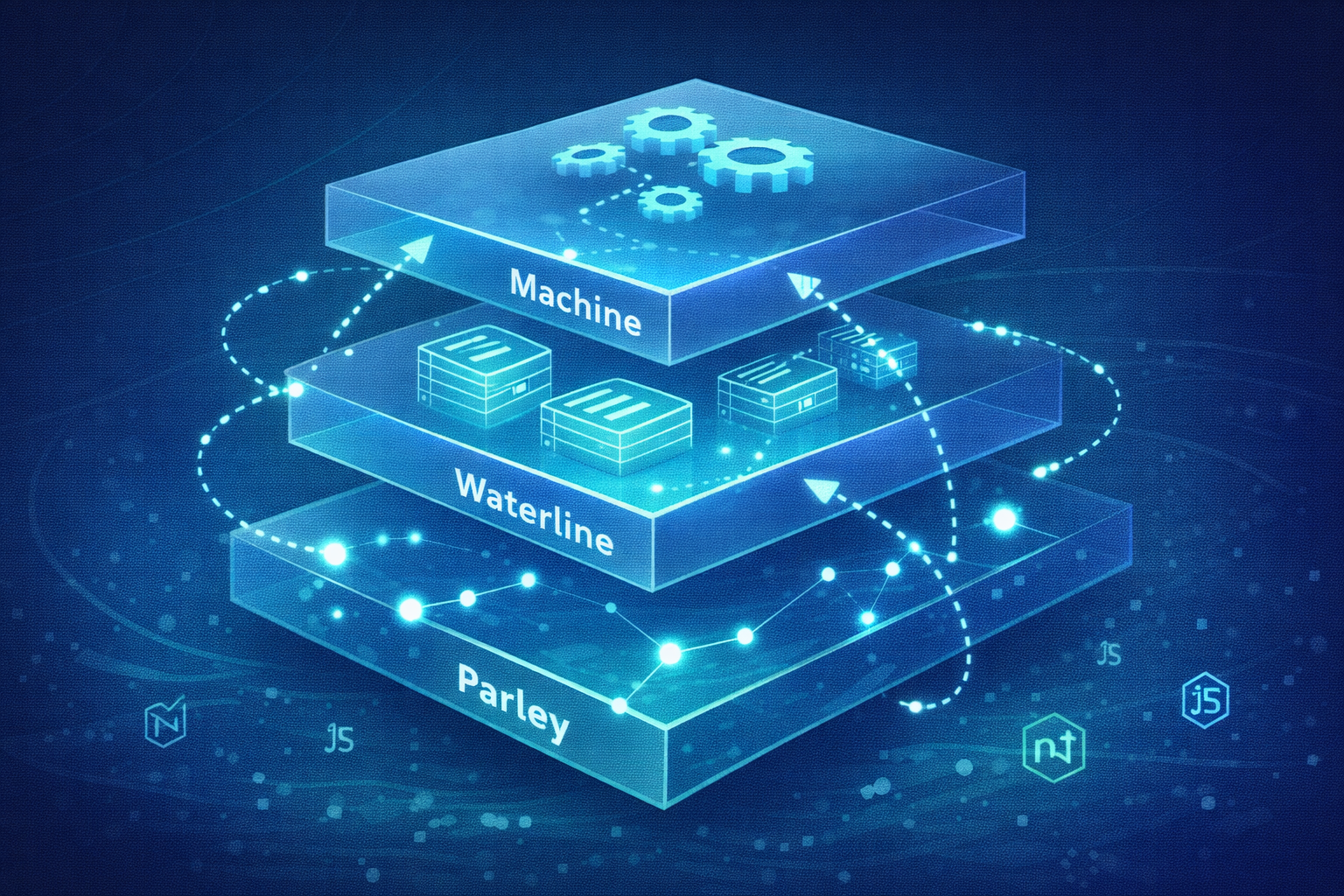
If you’ve ever used Waterline models or Sails helpers, you’ve already been using parley without knowing it.
Every time you write await User.find() or await sails.helpers.mail.send(), parley is working behind the scenes to give you a consistent, powerful async experience.
What is Parley?
Parley is a practical, lightweight flow control library for Node.js that predates native Promises. It implements a Deferred object pattern: a way to represent an operation that hasn’t executed yet but can be triggered in multiple ways.
Under the hood, parley uses Bluebird for its Promise implementation. When you call .then(), .catch(), or .toPromise() on a Deferred, parley uses Bluebird’s promisify to convert the callback-based execution into a Promise. This gives you access to Bluebird’s performance optimizations and advanced features like filtered .catch() handlers, while keeping the Deferred pattern’s lazy execution semantics.
What makes parley special is that it supports three async paradigms simultaneously:
// Modern async/await (recommended)
const users = await User.find({ active: true });

// Node-style callbacks
User.find({ active: true }).exec((err, users) => {
  if (err) { return this.res.serverError(err); }
  // ...
});

// Promise chaining
User.find({ active: true })
  .then(users => { /* ... */ })
  .catch(err => { /* ... */ });
The same function call works with all three styles. No wrapper needed, no separate APIs to learn.
The Deferred Object
At the heart of parley is the Deferred object, and understanding it unlocks how async operations work throughout Sails.
The core idea is lazy execution: when you call something like User.find(), nothing happens immediately. Instead of hitting the database right away, Waterline hands you back a Deferred, an object that holds your query logic and waits for you to say “go.” This is fundamentally different from Promises, which start executing the moment you create them.
What is a Deferred?
A Deferred is an object that represents a future computation. It’s work that will happen, but hasn’t happened yet. Think of it like a movie ticket: you have the ticket in hand, but you haven’t watched the movie. The ticket gives you the ability to watch the movie whenever you’re ready.
When you call User.find(), Waterline doesn’t immediately hit the database. Instead, it returns a Deferred object, essentially a “ticket” that says: “I know how to query the database. Just tell me when.”
// This does NOT query the database yet
const deferred = User.find({ active: true });

// The deferred is just sitting there, waiting
console.log(deferred); // [Deferred]

// NOW it queries the database
const users = await deferred;
Why Lazy Execution?
This lazy execution pattern is powerful for several reasons:
1. Method Chaining Before Execution
Because the query hasn’t run yet, you can keep adding to it:
const deferred = User.find();

// Build up the query piece by piece
deferred.where({ status: 'active' });
deferred.sort('createdAt DESC');
deferred.limit(10);

// Execute when ready
const users = await deferred;
Or more commonly, chained fluently:
const users = await User.find()
  .where({ status: 'active' })
  .sort('createdAt DESC')
  .limit(10);
2. Conditional Execution
You can decide whether to execute based on runtime conditions:
const query = User.find({ role: 'admin' });

if (needsResults) {
  const admins = await query;
  // do something with admins
}
// If needsResults is false, no database query ever happens
3. Passing Around Unexecuted Queries
You can pass a Deferred to another function that decides when (or if) to execute it:
function maybeExecute(deferred, shouldRun) {
  if (shouldRun) {
    return deferred; // Caller will await this
  }
  return null;
}

const result = await maybeExecute(User.find(), true);
Deferred vs Promise
You might wonder: “Isn’t this just a Promise?” Not quite. Here’s the key difference:
Promises execute immediately:
// This starts fetching RIGHT NOW, whether you want it to or not
const promise = fetch('https://api.example.com/users');
Deferreds wait for you:
// This does nothing until you call .exec(), await, or .then()
const deferred = User.find();
Parley’s Deferred becomes a Promise when you need it to (via .then(), .catch(), or await), but it doesn’t force immediate execution. This gives you control over when the work happens.
The Deferred Lifecycle
Here’s what happens inside a Deferred:
- Creation:
User.find()creates a Deferred with your query logic stored inside - Configuration: Chainable methods (
.where(),.timeout(), etc.) modify the Deferred’s state - Execution: When you call
.exec(),await, or.then(), the stored logic finally runs - Resolution: The callback/promise resolves with the result or rejects with an error
// 1. Creation - stores the "find" logic
const deferred = User.find({ active: true });

// 2. Configuration - adds timeout behavior
deferred.timeout(5000);

// 3. Execution - NOW the database is queried
// 4. Resolution - users contains the result
const users = await deferred;
Anatomy of a Deferred
Under the hood, a Deferred is a carefully designed object that tracks its own state through the execution lifecycle. Understanding its internal properties helps demystify what parley is doing behind the scenes.
Core Internal Properties:
| Property | Purpose |
|---|---|
_handleExec | The function containing the actual logic to execute (your query, helper, etc.) |
_hasBegunExecuting | Spinlock flag preventing double-execution |
_hasFinishedExecuting | Tracks whether the operation has completed |
_hasTimedOut | Set to true if a timeout occurred |
_timeout | The configured timeout in milliseconds (if any) |
_omen | An Error snapshot for better stack traces |
_promise | Cached promise (created lazily when .then() or .toPromise() is called) |
_userlandAfterExecLCs | Array of .intercept() and .tolerate() handlers |
The Spinlock Pattern:
One of the most important safety features is the spinlock, which prevents a Deferred from executing more than once:
// Inside .exec() - simplified
if (this._hasBegunExecuting) {
  console.warn('This Deferred has already begun executing!');
  return; // Silently ignore duplicate execution
}
this._hasBegunExecuting = true;
This protects against race conditions when the same Deferred might accidentally be awaited twice.
Timeout Implementation:
When you call .timeout(5000), parley sets up a setTimeout that races against your operation:
// Simplified timeout flow
const timeoutAlarm = setTimeout(() => {
  this._hasTimedOut = true;
  callback(new TimeoutError('Took too long...'));
}, this._timeout);

// When operation completes normally, clear the alarm
clearTimeout(timeoutAlarm);
Error Negotiation Pipeline:
When an error occurs, it flows through a pipeline of handlers:
- First, parley checks for any
.intercept()or.tolerate()handlers that match the error - If a match is found, the handler runs (potentially transforming or swallowing the error)
- Finally, if there’s a
_finalAfterExecLC(used by Machine for post-processing), it runs - The final error (or result) is passed to your callback
This layered approach is what makes error negotiation so powerful. Each layer can inspect, modify, or handle errors before they reach your code.
Why This Matters:
Understanding the Deferred’s anatomy helps you:
- Debug timing issues: If you see “already begun executing” warnings, you know a Deferred is being triggered twice
- Understand timeout behavior: Timeouts are set up at execution time, not creation time
- Appreciate error flow: Your
.intercept()handlers run before Machine’s post-processing, giving you first crack at errors - Write better tests: You can check
deferred._hasBegunExecutingin tests to verify execution state
The Sails Ecosystem Connection
Parley is the async backbone of the Sails ecosystem, but its methods are extended and augmented as they flow through different layers:
- Parley provides the core Deferred pattern and base methods
- Waterline ORM uses parley for model methods and adds query-specific chainables like
.where(),.sort(),.usingConnection() - Machine (the engine behind Sails helpers) uses parley and adds helper-specific methods like
.retry(),.switch(), and.meta()
This layered architecture means you get a consistent base experience (thanks to parley), plus specialized methods depending on what you’re working with.
Parley’s Core Methods
These methods come directly from parley and work everywhere in Sails, on both Waterline queries and helpers.
Execution Methods
.exec(callback) executes with a Node-style callback:
User.find({ active: true }).exec((err, users) => {
  if (err) { return res.serverError(err); }
  return res.json(users);
});
.then() and .catch() provide Promise-style execution:
User.find({ active: true })
  .then(users => res.json(users))
  .catch(err => res.serverError(err));
.toPromise() converts to a Bluebird Promise for use with Promise.all():
const [users, posts, comments] = await Promise.all([
  User.find().toPromise(),
  Post.find().toPromise(),
  Comment.find().toPromise()
]);
Flow Control Methods
.timeout(milliseconds) sets a maximum wait time:
// Give up after 5 seconds
const user = await User.findOne({ id: 123 })
  .timeout(5000);
If exceeded, parley throws a TimeoutError. This is invaluable for preventing operations from hanging indefinitely.
Error Negotiation Methods
.tolerate(rule, [handler]) gracefully swallows specific errors:
// Return undefined if not found, instead of throwing
const user = await User.findOne({ email: '[email protected]' })
  .tolerate('notFound');

// Or provide a fallback value
const config = await sails.helpers.fs.readJson('./config.json')
  .tolerate('notFound', () => {
    return { defaults: true };
  });
The rule can be:
- A string matching an error code:
.tolerate('E_NOT_FOUND') - An array of error codes:
.tolerate(['E_NOT_FOUND', 'E_TIMEOUT']) - A dictionary filter:
.tolerate({ code: 'E_INVALID', status: 400 }) - A function for complex matching:
.tolerate(err => err.code.startsWith('E_'))
.intercept(rule, handler) catches and rethrows errors with modifications:
const user = await User.create({ email: '[email protected]' })
  .intercept('E_UNIQUE', (err) => {
    return new Error('That email address is already in use.');
  });
Unlike .tolerate(), which swallows errors, .intercept() transforms them before rethrowing. Perfect for converting low-level database errors into user-friendly messages.
Debugging Methods
.log() executes and logs the result (useful in the REPL):
User.find({ id: 1 }).log();
// Logs the full result with util.inspect
.now() executes synchronously (only for sync operations):
const result = sails.helpers.strings.random().now();Machine’s Augmentations
When you use Sails helpers, you’re using the Machine package, which wraps parley and adds several powerful methods. But helpers aren’t the only thing built with Machine.
The Machine package powers any callable that follows the node-machine specification: Sails helpers, payment integrations like Sails Pay methods, organics from sails-hook-organics, and any machinepack you might use.
This means that anything built with Machine automatically gets access to parley’s core methods plus these additional augmentations. Waterline queries, however, don’t go through Machine, so they only have access to parley’s core methods.
.retry(rule, [delaySeries])
Built-in exponential backoff for transient failures:
// Retry on timeout errors with default delays (250ms, 500ms, 1000ms)
const result = await sails.helpers.http.get('https://api.example.com/data')
  .timeout(5000)
  .retry('TimeoutError');

// Custom delay series: retry after 100ms, then 500ms, then 2000ms
const user = await sails.helpers.users.fetch(userId)
  .retry('E_SERVICE_UNAVAILABLE', [100, 500, 2000]);
The rule parameter works like .tolerate() and .intercept(). The optional delaySeries defaults to [250, 500, 1000] milliseconds.
.switch(handlers)
Handle multiple exits explicitly with a “switchback” pattern:
await sails.helpers.users.create({ email: '[email protected]' })
  .switch({
    success: (newUser) => {
      sails.log.info('Created user:', newUser.id);
      return res.json(newUser);
    },
    emailAlreadyInUse: () => {
      return res.badRequest('That email is taken.');
    },
    error: (err) => {
      return res.serverError(err);
    }
  });
This is particularly useful when a helper has multiple named exits beyond just success and error. Each exit gets its own handler, making the control flow explicit.
.meta(dictionary)
Pass metadata to the helper’s implementation via this:
const result = await sails.helpers.email.send({
  to: '[email protected]',
  subject: 'Welcome!'
})
.meta({
  skipActuallySending: true,  // Available as this.skipActuallySending in the helper
  customSmtpHost: 'smtp.custom.com'
});
Inside the helper, you access metadata through this:
// In api/helpers/email/send.js
fn: async function(inputs) {
  if (this.skipActuallySending) {
    sails.log.info('Skipping email send (meta flag set)');
    return;
  }
  // Actually send the email...
}
Waterline’s Additions (Models Only)
Waterline adds its own chainable methods on top of parley for query building. These only work on model methods.
.usingConnection(db)
Use a specific database connection (useful for transactions):
await sails.getDatastore().transaction(async (db) => {
  await User.create({ name: 'Test' }).usingConnection(db);
  await Profile.create({ userId: newUser.id }).usingConnection(db);
  // If anything fails, both operations roll back
});
Query Building Methods
Methods like .where(), .sort(), .limit(), .skip(), .select(), .populate(), and .fetch() are Waterline-specific:
const users = await User.find()
  .where({ status: 'active' })
  .sort('createdAt DESC')
  .limit(10)
  .populate('posts');
These are implemented as custom chainable methods on the parley Deferred.
Methods Summary
Here’s a quick reference of what’s available where:
| Method | Parley (Core) | Waterline | Machine |
|---|---|---|---|
.exec() | ✓ | ✓ | ✓ |
.then()/.catch() | ✓ | ✓ | ✓ |
.toPromise() | ✓ | ✓ | ✓ |
.timeout() | ✓ | ✓ | ✓ |
.tolerate() | ✓ | ✓ | ✓ |
.intercept() | ✓ | ✓ | ✓ |
.log() | ✓ | ✓ | ✓ |
.now() | ✓ | ✓ | ✓ |
.retry() | ✓ | ||
.switch() | ✓ | ||
.meta() | ✓ | ✓ | |
.usingConnection() | ✓ | ||
.where()/.sort()/etc | ✓ |
Machine-powered callables include: Sails helpers, sails.pay methods, sails-hook-organics, and any machinepack.
Error Negotiation in Practice
One of parley’s most practical features is error negotiation. In Sails, errors often have a code property that identifies the type of failure:
// In your helper
fn: async function(inputs) {
  const user = await User.findOne({ id: inputs.userId });
  if (!user) {
    throw { code: 'E_USER_NOT_FOUND', message: 'No user with that ID exists' };
  }
  return user;
}
Then in your action, you can handle errors declaratively:
// Handle specific errors differently
const user = await sails.helpers.users.lookup(userId)
  .intercept('E_USER_NOT_FOUND', () => 'notFound')
  .intercept('E_UNAUTHORIZED', () => 'forbidden');
Or use .switch() for helpers with multiple exits:
await sails.helpers.users.lookup(userId)
  .switch({
    success: (user) => res.json(user),
    notFound: () => res.notFound(),
    unauthorized: () => res.forbidden(),
    error: (err) => res.serverError(err)
  });
The 15-Second Warning
In development, parley watches for Deferreds that are created but never executed. If you forget an await:
// Oops! Missing await
User.find({ active: true });  // This does nothing!
After 15 seconds, parley logs a warning:
WARNING: A function that was initially called over 15 seconds
ago has still not actually been executed. Any chance the
source code is missing an "await"?
This catches a common mistake that would otherwise be silently ignored.
Performance
Parley is designed for performance-critical code paths:
- 28M ops/sec for building a Deferred
- 3.2M ops/sec for build + execute
- Prototypal implementation (not closures) for hot code paths
- Minimal validation in production mode
For the ultimate performance, you can bypass the Deferred entirely by passing a callback directly:
// Slightly faster because parley doesn't create a Deferred
User.find({ active: true }, (err, users) => {
  // Direct callback
});
Building Your Own Parley-Powered Functions
If you’re building a library or want consistent async behavior, you can use parley directly:
const parley = require('parley');

function fetchUser(id) {
  return parley((done) => {
    // Your async logic here
    db.query('SELECT * FROM users WHERE id = ?', [id], (err, rows) => {
      if (err) { return done(err); }
      if (!rows.length) {
        return done({ code: 'E_NOT_FOUND', message: 'User not found' });
      }
      return done(undefined, rows[0]);
    });
  });
}

// Now consumers can use any style:
const user = await fetchUser(123);
// or
fetchUser(123).exec((err, user) => { /* ... */ });
You can even add custom chainable methods:
function buildQuery() {
  let criteria = {};

  return parley((done) => {
    db.find(criteria, done);
  }, undefined, {
    where: function(clause) {
      criteria.where = clause;
      return this;
    },
    limit: function(n) {
      criteria.limit = n;
      return this;
    },
    sort: function(field) {
      criteria.sort = field;
      return this;
    }
  });
}

// Use it like Waterline:
const results = await buildQuery()
  .where({ status: 'active' })
  .limit(10)
  .sort('createdAt DESC');
Why “Parley”?
The name comes from the nautical term for a conference between opposing parties. It’s fitting for a library that negotiates between different async paradigms, and it’s also a nod to Sails’ nautical theme.
Conclusion
Parley is one of those foundational packages that makes the Sails developer experience smooth without demanding attention. The Deferred pattern it implements gives you lazy execution, method chaining, and flexibility in how you handle async code, whether you prefer await, callbacks, or promises.
The next time you chain a .timeout(5000) onto a slow database query or use .tolerate() to handle a missing file gracefully, you’ll know exactly what’s making that possible, and why that User.find() doesn’t hit the database until you tell it to.